

There’s no risk of burnout here
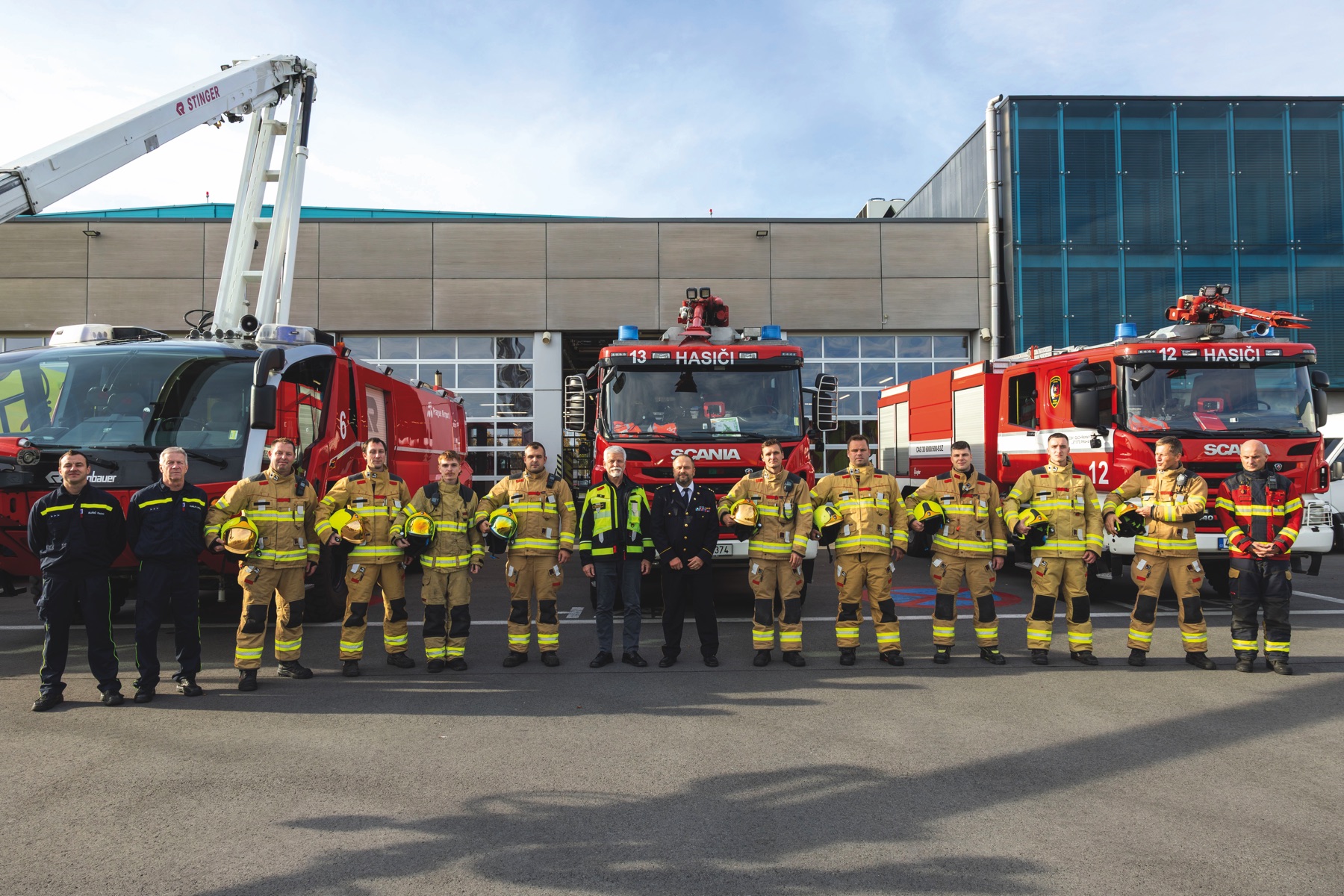
President Petr Pavel, Pavel Hošek and the airport fire department team
Text: Martina Hošková, M. Zisso; Photo: Archive
Let us open this interview with a standard yet important question. Can you tell us a bit about yourself?
My name is Pavel Hošek, and I work at Prague Airport as the Director of the Airport Rescue and Fire Brigade. My firefighting career began in 1989, when, after completing my compulsory military service, I joined the Fire Rescue Service of the Capital City of Prague as a young firefighter. I served with the Prague firefighters for 23 years and worked my way up to the position of shift commander, which means that on a given day, you are in charge of all units in Prague. In 2018, I became the head of the Prague Airport Rescue and Fire Brigade.
The Prague Airport Rescue and Fire Brigade is celebrating its 80th anniversary this year. Can you give us some notable highlights?
The first written record of a fire unit at Ruzyně dates back to 1945. However, we can assume that organised fire protection at the airport existed from its very beginning, in 1937.
Each year, the airport firefighters respond to around 600 incidents. The most common are fuel spills and smoke detector alerts. These are supplemented by assistance and interventions in the surrounding area, such as accidents on motorways D7, D6, and D0. False alarms are also frequent.
The Prague Airport Rescue and Fire Brigade consists of 104 personnel. Of those, 84 are operational firefighters divided into four shifts. The team also includes eight daytime staff and 12 dispatchers – 11 of whom are women. Each shift includes 21 firefighters, divided into specific crews: two for airside operations and one for building interventions. In the event of a major emergency, all crews are deployed.
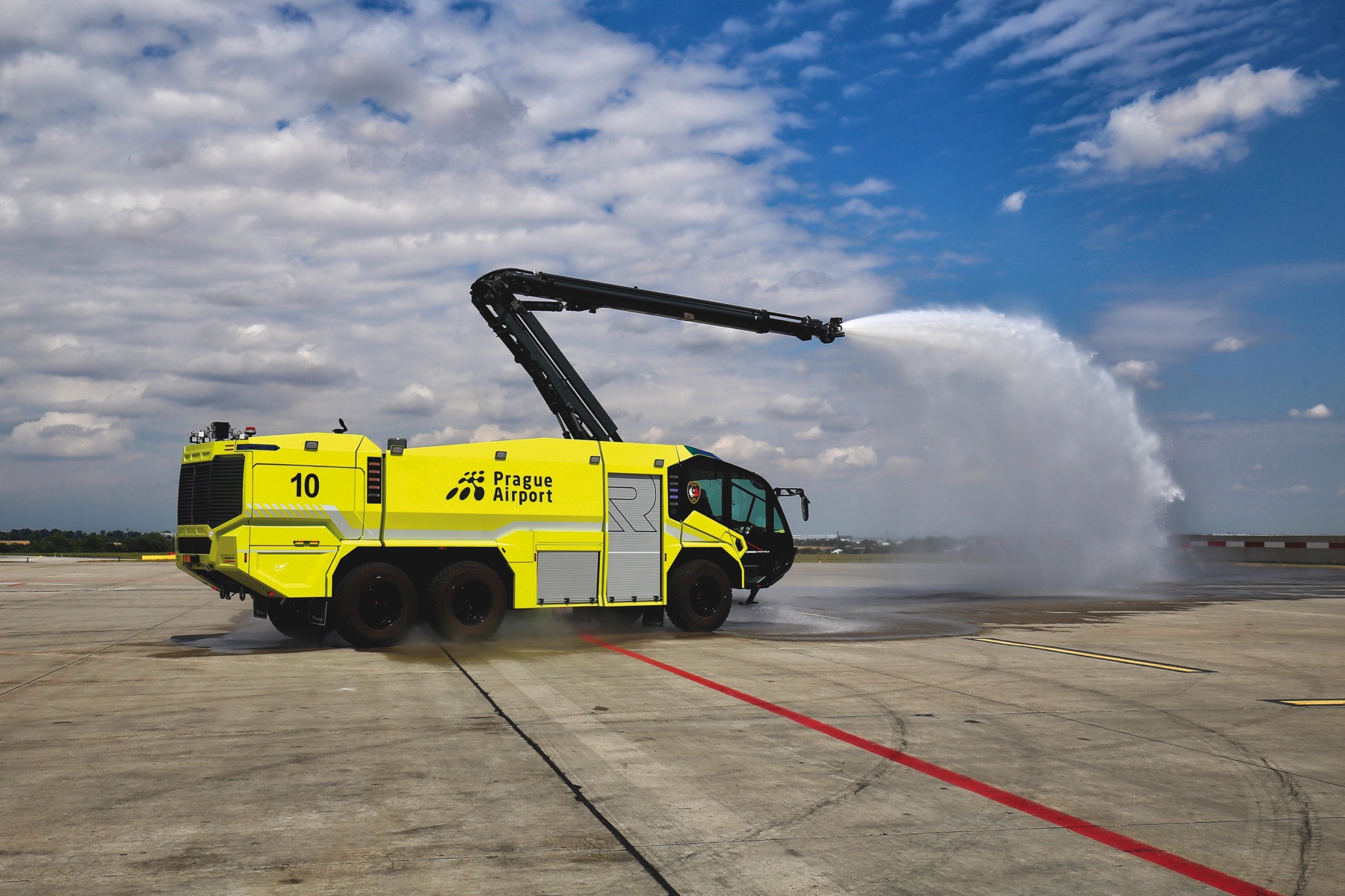
There are two fire stations on the airport grounds – one central and one satellite. Vehicles must be dispatched within 45 seconds to ensure they can reach any location within the airport premises in 2 to 3 minutes and begin an intervention.
Looking ahead, a brand-new satellite station is planned in connection with the construction of a new parallel runway. The current central station was already built with this future development in mind, and is located accordingly.
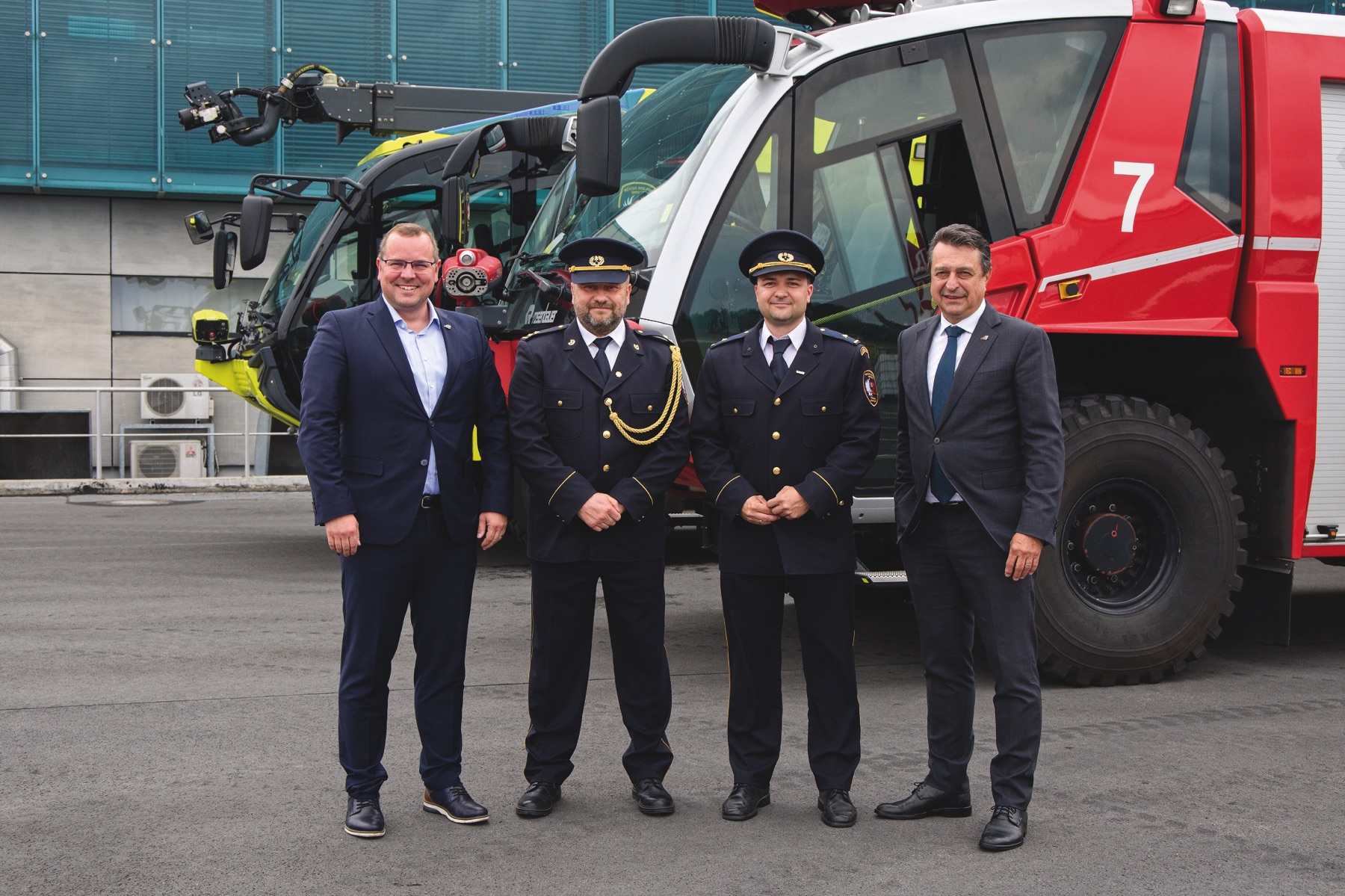
From left: Martin Kučera, Member of the Board of Directors, Pavel Hošek, Zdeněk Čelikovský, Jiří Pos, Chairman of the Board of Directors
Is there any difference between a common firefighter and an airport firefighter?
Airport firefighters, state firefighters, company firefighters, volunteer firefighters; it can be a bit complicated to distinguish and understand the differences, but I will try to explain. We are company employees, but we have the same education as state firefighters. We also attend joint courses and share some of the qualifications. The main difference is that an airport firefighter must additionally obtain the ARFF (Aircraft Rescue and Firefighting) certification, which involves training in extinguishing burning fuel and responding to aircraft incidents.
How did you get the idea of becoming a firefighter?
When I was younger, I was very active and loved sports. I played ice hockey competitively and spent my free time playing football, tennis, and cycling a lot. I was always part of a team where we motivated each other and competed. When I started my compulsory military service, being in good physical shape really came in handy.
My path to becoming a firefighter was quite straightforward. My best friend finished his military service a bit earlier than I did and joined the fire brigade. So, when I returned, I followed in his footsteps. I quickly grew to love the job. It wasn’t easy at all – it was demanding and dangerous work, with low financial compensation.
Over the years, an incredible number of things have changed, but I stayed in the profession, while my friend moved on. I still enjoy the work, I pass on my experience to younger colleagues, and together we strive to improve things and come up with new ideas.
Is there something which can be described as “a typical workday” at your position?
Prague Airport is a very dynamic and complex environment where all organisational units must work together to ensure that passengers have everything they need and that they enjoy their travel experience. An essential part of the entire system must be travel safety, and that is precisely our main task and goal.
My job essentially combines the role of the highest-ranking commander of the fire brigade with that of a manager. I deal with budgeting, development, technical equipment, fleet renewal, facility modernisation, training, and planning. Every morning, I meet with the fire brigade management to share all the necessary updates. This helps us stay informed about what is happening within the team and allows us to cover for each other when needed. Throughout the day, I also take part in airport management activities: attending meetings, negotiations, and working in various committees.
I’ve been serving as the Director of the Prague Airport Rescue and Fire Brigade for eight years, and I have to say that every day is different – there’s no risk of burnout here.
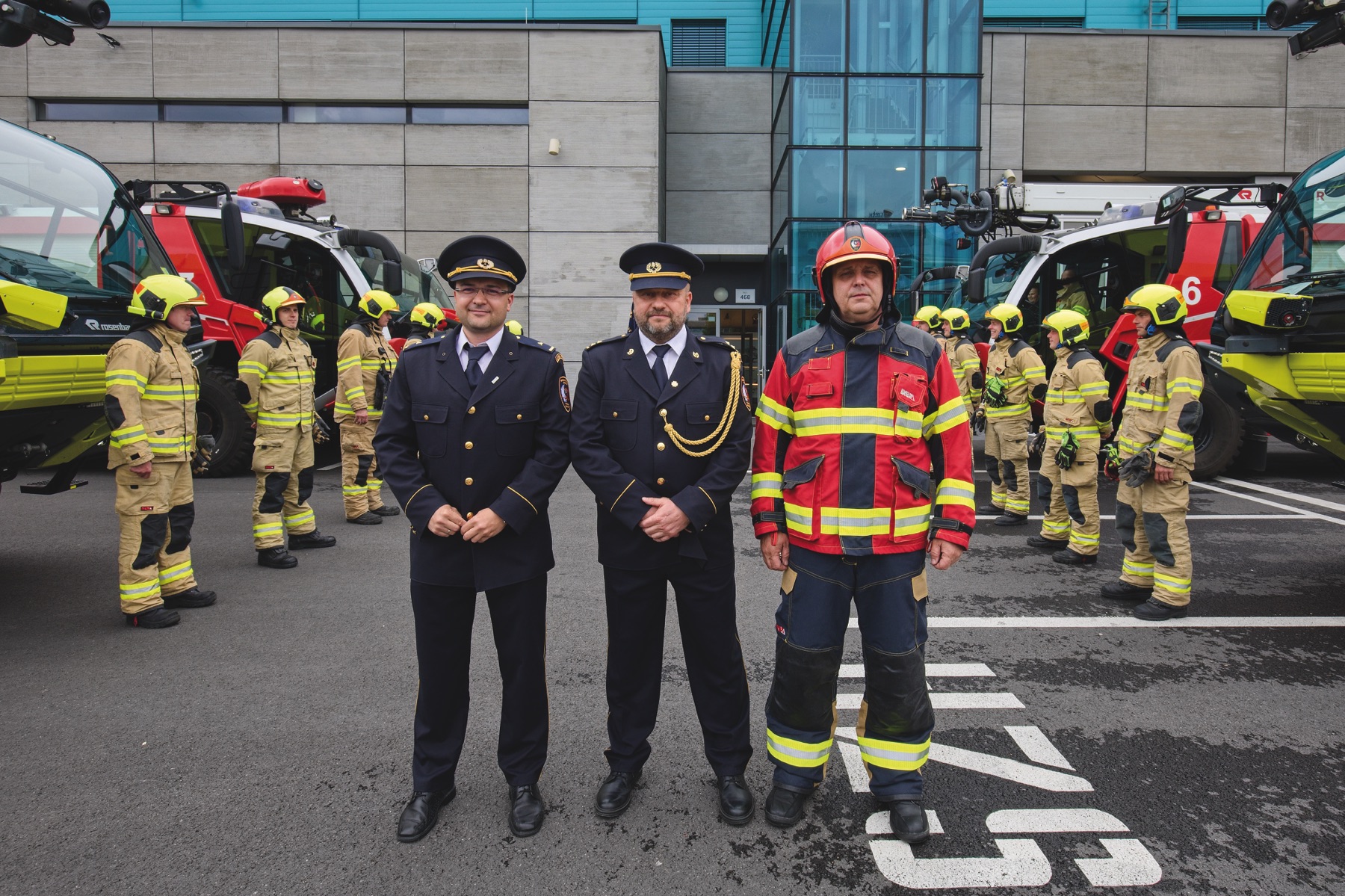
Pavel Hošek (in the middle) with Zdeněk Čelikovský, training and fire protection specialist and Jiří Nestrašil, shift B commander
What are your responsibilities as the head of the team?
As I already explained, this position combines the role of a commander with that of a manager. That said, the role of an active firefighter is now a bit out of reach for me, simply because there’s no time for it anymore.
As the head of a large rescue service, I need to ensure it is in operational synergy with my team – this includes having enough personnel and resources, training, qualifications, equipment, the condition of fire stations, and meeting all requirements for inspections and audits.
I try to present well-prepared plans and proposals to our board. We have strong support, and our unit is doing well in this regard – we are highly rated, and our reputation is excellent.
One of the least favourite parts of any leader’s job is dealing with conflicts. Are you no exception to that rule?
Our work is not easy, and conflicts do arise from time to time. Sometimes I have to restrict people’s rights during our emergency response, and other times I have to deal with disagreements in the workplace.
Being a firefighter brings about a number of extraordinary situations. Can you share some with us?
I’ve had many experiences and adventures. As both a firefighter and a commander, I’ve responded to numerous fires, traffic accidents, floods, and windstorms.
For example, I was part of the USAR team in Iran in 2003, where a major earthquake struck, and the Czech unit did an outstanding job there.
During major floods, I was deployed to various parts of the Czech Republic, where we rescued people, animals, and property, as well as creating survival shelters.
As a firefighter – and especially as a commander – I’ve been involved in major fires in Prague, such as the SAPA market fire, the Florenc train station, the Vinohrady brewery, and many apartment fires. I’ve also served as a negotiator in suicide attempt situations.
Is there a particularly unusual situation that you remember?
It happened a long time ago, but the story is still vivid in my mind – and hopefully, the person I saved is still alive and enjoying life. I was serving as the shift commander, and therefore the incident commander, during an event where a young man was about to jump off the Nusle Bridge. He was already sitting on top of the high protective fence, had thrown down his shoes and bag, and refused to communicate. After some time, I managed to start a conversation with him – probably because I wasn’t wearing firefighting gear, just my uniform: a shirt and trousers.
He told me he hadn’t even finished high school, didn’t believe in himself, and wanted to end it all by jumping over 40 meters down from the bridge. Based on his behaviour, we assessed that he was serious about his statement. Eventually, I convinced him that I couldn’t hear him well and that I would climb up to him using an attached ladder. There wasn’t time to secure myself with a rope, so I just nodded to my colleagues to watch me and hold my ankles.
I climbed up behind him, continuing to talk to him. But he realised I was trying to grab him. He tried to hit me with his elbow, but I blocked the blow, grabbed him tightly around the chest and arms, and pulled him back onto the bridge. The emergency medical team took over from there. Only then did I realise what had just happened, how risky it was – and my knees started to shake a little.
But the young man was saved, and that was what mattered the most.
What would you say is the most difficult part of your job?
When I served as a firefighter and later as a commander in Prague, the entire shift was extremely demanding. We worked 24-hour shifts followed by two days off. If you were called out to an incident during the night and spent the whole night there, the exhaustion was intense.
It’s definitely a physically and mentally demanding job for all firefighters, especially because they witness the aftermath of fires, accidents, and natural disasters.
Does your free time enable you to recover from the strains of a demanding job?
These days, I really value my free time. As you get older, you realise how important it is to enjoy life during your time off and to do things for your health. So, I spend a lot of time in nature – going on trips and holidays. I really enjoy manual work; I have a house and a garden, and there’s always something to do there. One of my big hobbies is riding my motorcycle and going on road trips.
I’ll admit, sometimes I also enjoy just lying on the couch, reading a book, or simply relaxing. And why not? That’s part of life too.