

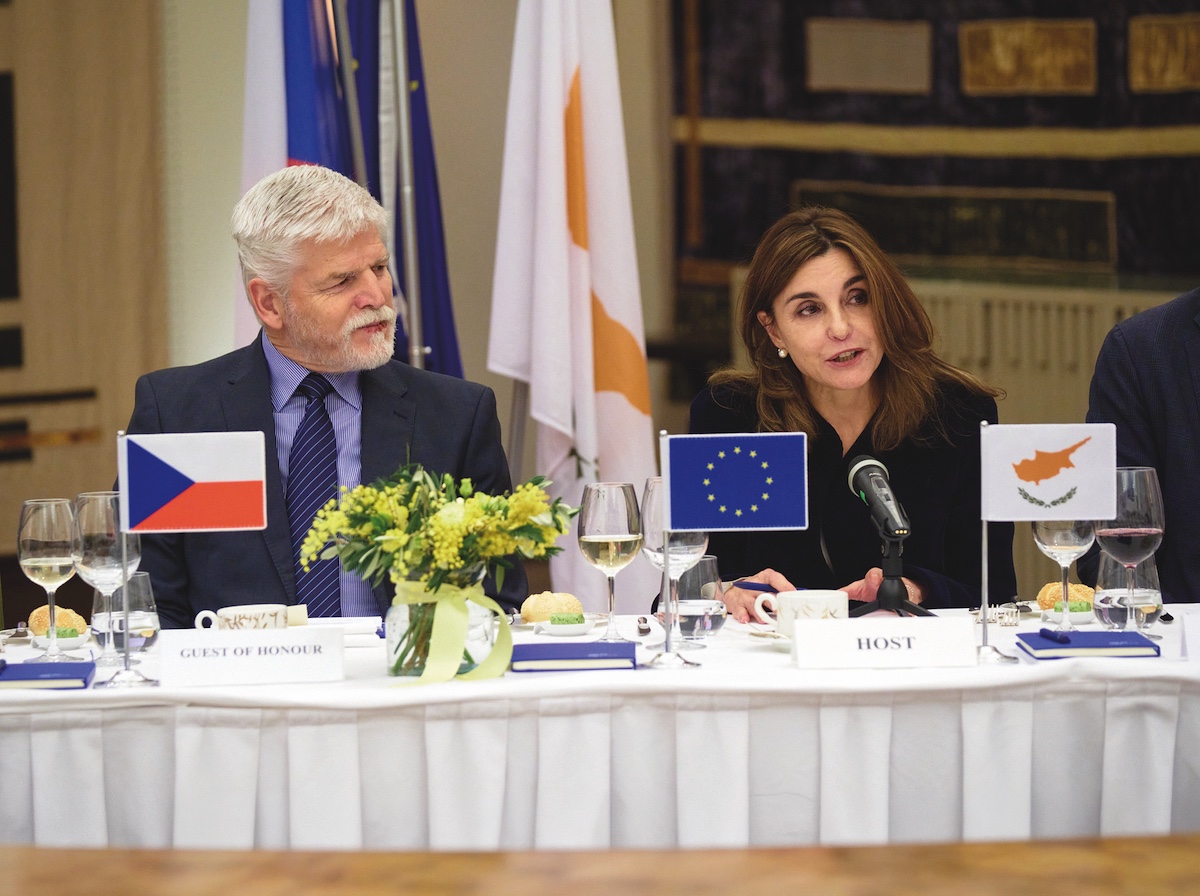
President of the Czech Republic Mr. Petr Pavel and Ambassador of the Republic of Cyprus to the Czech Republic H.E. Ms. Aliki Paschali
Text: H.E. Ms. Aliki Paschali, Ambassador of the Republic of Cyprus to the Czech Republic; Photo: Archive

Fourteen years after our first EU Presidency, the current global system stands in stark contrast. The Presidency in 2026 comes at a time of heightened geopolitical and geoeconomic challenges, marked by volatility and uncertainty. The international order, upon which we relied for decades, is no longer a given.
Russia’s aggression against Ukraine, conflicts in our Southern neighbourhood and the wider Middle East, events that have recently occurred in the Western Hemisphere, the resurgence of territorial claims for Greenland, and a shifting US global posture have all defined a new security situation.
By assuming the Presidency, Cyprus adds a new element to the equation: it is the member state closest to the Eastern Mediterranean and the Middle East, a region that is essential for European competitiveness. Cyprus is also a country with a proven record of actively promoting regional cooperation, stability, and security, as well as serving as a bridge between Europe and the Middle East.
This experience can be converted into new initiatives, helping shape the EU agenda and contribute to the Union’s broader goals, especially in the domains of energy and water security, territorial cohesion, climate resilience, connectivity, and competitiveness, providing an example of how a peripheral, small, island member state can both lead and reinforce the EU’s strategic autonomy.
Influence does not depend only on size, but also on the ability to make the most of one’s relative advantages. The “weight” of a member state is not only determined by square kilometres alone, but also by its know-how, efficiency, and commitment to strengthening the “European project”.
Autonomy through security, defence, and readiness is one of the core issues of our priorities. Russia’s aggression has clearly demonstrated the need to strengthen the European security architecture and our defence readiness.
The Cyprus Presidency will stand firmly with Ukraine, continuing support at all fronts, while at the same time supporting international efforts for a viable peace, in line with the UN Charter and safeguarding the country’s sovereignty and territorial integrity.
As a Member State whose territory has been under military occupation for more than five decades, we know all too well the stakes.
I need not underline, that an autonomous Union is above all a secure Union. However, security today is not mono-dimensional. It is multi-layered and interconnected, and that is why the Cyprus Presidency will advance a comprehensive approach to security, which also includes maritime and economic security.
It is not the Cyprus Presidency’s business to transform European Union foreign policy, but this is an area where a small state, with clear interests, regional exposure, and a willingness to push, could make a difference. It can convert geographic context into coordinated action.
Effective migration management is another core dimension of security.
As a frontline member state, Cyprus will work towards a balanced and comprehensive European approach, addressing both internal and external dimensions, tackling root causes, strengthening cooperation with key third countries, and ensuring full implementation of the Pact on Migration and Asylum and progress on the EU Return Regulation.
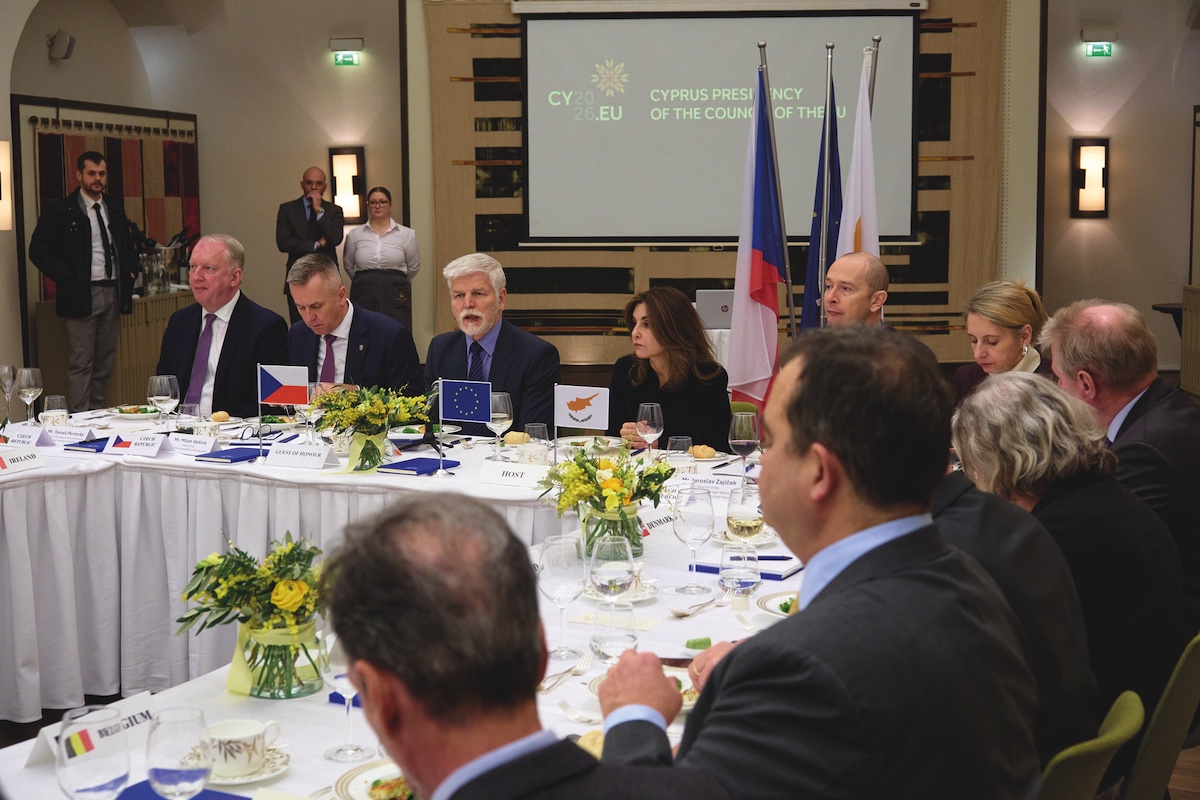
The first luncheon of the Cyprus Presidency of the EU Council for the EU Heads of Mission in Prague
We shall also focus on strengthening competitiveness. We must make Europe faster, smarter, simpler. We must deliver more and better for our businesses and individuals. We must push a simplification agenda that reduces burdens in a balanced manner, especially for small and medium-sized enterprises (SMEs), the backbone of our economy. We will work hand-in-hand with the European Parliament to conclude key files that cut red tape.
Competitiveness, however, is not only about removing obstacles – it is also about building capability. Completing and strengthening our Single Market, deepening the capital markets through the Savings and Investment Union, remain central to European integration. We will prioritise the modernisation of our industries, Europe’s ability to innovate and produce the technologies of tomorrow, while advancing green and digital transition.
Competitiveness must also be inclusive. It must benefit all regions, including island, peripheral, and less-connected areas. Connectivity is essential.
Cyprus fully supports the EU’s climate neutrality goals, but underlines that small island states face unique challenges, including energy isolation and high transition costs.
The Cyprus Presidency also aims to increase the EU’s visibility and act as enabler to reinforce the Union’s role as a strategic global actor. This will be achieved by making better use of its toolbox, as well as building on strong partnerships across all regions of the world.
From Ukraine and Moldova, to the Western Balkans and Turkey, enlargement is the Union’s most powerful and transformative geopolitical tool.
The Cyprus Presidency will promote a credible, merit-based enlargement agenda, aimed at delivering tangible benefits, while ensuring respect for the Union’s values and principles, democratic standards, the rule of law, common foreign and security policy alignment, and international law.
Our engagement with the Southern Neighbourhood and the Gulf is equally strategic. The New Pact for the Mediterranean provides a vital framework, and the Cyprus Presidency will promote its objectives with initiatives such as IMEC (India Middle East Economic Corridor), leveraging Cyprus’ strong ties with the Middle East, the Gulf, and India.
A Union that is open to the world is also a Union capable of responding swiftly and effectively to crises. We will work to enhance the EU’s capacity for rapid and effective crisis response and fostering synergies, building on Cyprus’ experience as a regional hub for evacuations and humanitarian aid.
Another pillar of the Cyprus Presidency’s priorities, is an autonomous Union of values for all, and without discrimination.
A truly autonomous Europe requires strong social cohesion, where no person or region is excluded. This means tackling poverty and ensuring access to affordable housing and energy.
In this regard, the Cyprus Presidency will focus on affordable housing, promoting the implementation of the European Affordable Housing Plan, with full respect for the principle of subsidiarity and national competences.
The fifth pillar of our priorities is a budget needed to support the four others, and which effectively supports the goal of an autonomous Union (Multiannual Financial Framework for 2028–2034).
Our aim is to guide discussions in a way that will facilitate reaching political agreement on the MFF by the end of 2026. The stakes are high, and this will be reflected in the difficulties of negotiations, but we retain our ambition on this most crucial of files.
 The world is entering a new phase of hard geopolitics, where power, resources, and geographical nodes are returning to the centre of international politics. For the EU, the real question is not if it will be affected, but whether it will limit itself to the role of observer or instead utilize this new reality to become a co-shaper of developments, strengthening itself and its unity through these challenges.
As Robert Schuman reminds us, “Europe will not be made all at once, or according to a single plan. It will be built through concrete achievements, which first create a de facto solidarity.”