


Text: Ondřej Preuss, Attorney and Founder of DostupnyAdvokat.cz; Introduction: Martina Hošková; Photo: Archive
Do you go to work with a dumpling in your throat? Does your supervisor put you down in front of your colleagues, ignore your results, or give you impossible tasks? Maybe it’s not “just” a bad atmosphere, but bossing or mobbing. In this article, we explain how to recognize workplace bullying, when it is already illegal, and how to defend yourself against it.
The definition of bullying
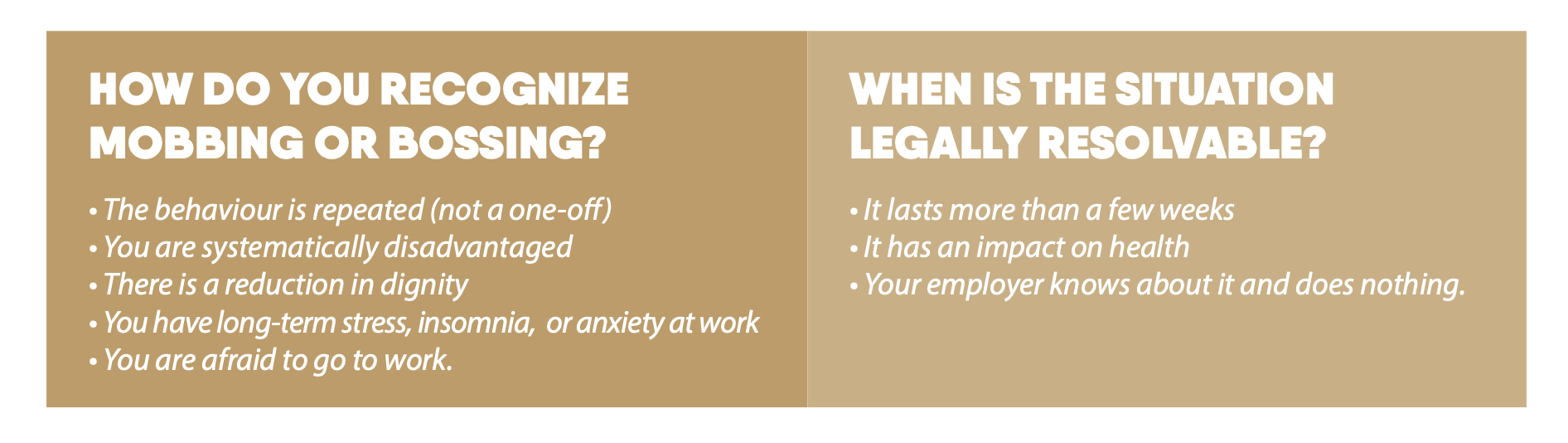
Bullying is a form of repeated abuse, humiliation, or harassment of someone. It usually takes place in an environment where the bully has power over the victim. Bullying can be physical, verbal (e.g. derogatory remarks, taunting), or emotional (e.g. excluding, ignoring). It often occurs in schools, work environments, or online.
It is important to distinguish between bullying and one-off conflicts or minor disagreements that are common in everyday life. Bullying is characterised by its persistent, repeated nature and has serious negative consequences for the victim, including psychological problems, anxiety, depression, or even physical health problems.
The specifics of workplace bullying
Workplace bullying most often manifests itself as long-standing hostile relationships, which, over time, turn into humiliation and ridicule. The specifics include the fact that it takes place in the work environment, and thus affects work performance and the overall atmosphere of the work environment.
Workplace bullying is also specific in that it usually involves an element of power, where the bully uses his or her position (e.g. managerial position) to humiliate or control the victim. This type of bullying is called bossing. However, bullying can also occur between colleagues who are at the same level of power at work. In this case, it is called mobbing.
The definition of bossing
As we have already mentioned, bossing is a form of workplace bullying that is directed by supervisors towards subordinates. It is a systematic and repeated pattern of behaviour designed to humiliate, intimidate, control, or otherwise harm the victim.
Specific manifestations of bossing include:
- Constant criticism and humiliation.
- Inadequate delegation of work or overloading with unwanted tasks.
- Isolation from the team or ignoring the victim’s contributions.
- Threatening, blackmailing, or spreading rumours and gossip.
Restrictions on career opportunities or access to information. An example of bossing is when a supervisor repeatedly points out employee’s mistakes without offering specific examples or opportunities to improve. The criticism is delivered in a way that is demeaning and ridiculing to the subordinate. However, it is not bossing when it is constructive criticism. For example, when the supervisor regularly provides feedback to the employee that is balanced between acknowledging positive contributions and specific areas that could be improved.
The definition of mobbing
Mobbing is workplace bullying between colleagues. It is therefore systematic and repeated behaviour that is intended to humiliate, intimidate, control, or otherwise harm a colleague who is not in a subordinate position.
Mobbing most often manifests itself verbally in the form of humiliation and insults. However, jokes and taunts that go beyond what is acceptable are also common. Another common manifestation is isolation, manifested by excluding a colleague from group activities, ignoring their presence or contributions.
An example of mobbing is when a group of employees forms in a work environment and begins to systematically ignore and exclude a new colleague. They ignore him/ her at social events, do not include him/her in important meetings, do not take his/her ideas into account, and avoid him/her in joint work activities.
The consequences of bullying
Workplace bullying can have widespread and serious consequences for both the individual and the workplace. It affects bullied individuals both psychologically and physically. It causes long-term stress, anxiety, and depression. The stress caused by bullying can then lead to physical symptoms such as headaches, digestive problems, or sleep problems.
Bullying also affects the work performance of the bullied person as it causes a decline in work performance. It limits their opportunities for career progression, and can even lead to the termination of the working relationship.
In the work environment, it often impairs teamwork and creates an unpleasant working environment. This in turn leads to reduced work performance and increased staff turnover, which in turn causes economic downturns and increases staff costs.
Bullying does not have to be discrimination
Bullying is often confused with discrimination in the workplace, which has its own legal provisions. And yes, in some cases bullying does manifest itself as discrimination, but often it is not. In fact, discrimination is based on treating employees differently based on their sexual orientation, nationality, race, origin, gender, etc. It is therefore disadvantaging an individual or group on the basis of their identity.
Discrimination is therefore based on specific criteria (e.g. race, gender), whereas bullying may have different motivations (e.g. power or personal).
Examples of discrimination include the situation where an employer refuses to hire a person because of his or her race, even though he or she has the necessary qualifications, or the common situation where a company pays men better than women who do the same job with comparable efficiency.
How to defend yourself against workplace bullying
Unfortunately, defending yourself against bullying is not always easy. In fact, bullying is often difficult to prove. However, there are options:
- Talk to the bully: If you feel up to it, try talking directly to the person who is bullying you. Sometimes it may be unconscious behaviour that can be resolved by bringing it to the bully’s attention and telling them how it is affecting you.
- Get evidence: It is important to keep a record of any bullying incidents, including the date, time, participants, and the specific behaviour that happened. Having written documentation can be key in addressing the issue. If possible, try to take video footage that clearly shows the bullying, for example.
- Contact your supervisor or HR department. Companies should have procedures for dealing with bullying and protecting employees. Alternatively, you can make a formal complaint to your employer, which they are legally obliged to deal with.
- Send a pre-action notice: If you have been harmed as a result of bullying, you can take your case directly to court. However, it is a good idea to send a pre-suit notice first before actually filing a lawsuit. This alone can often achieve the desired result.
- File a lawsuit: If the pre-suit notice doesn’t work, it’s time to file the lawsuit itself, though it can be somewhat problematic. This is because unless the bullying is based on discrimination, the burden of proof is on you. This means you must have evidence (such as witnesses or video footage) to back up your argument.
- Contact the labour inspectorate: if the employer does not resolve the situation, you can file a complaint with the labour inspectorate. Describe the situation and attach the evidence obtained. The inspectorate should inspect your employer’s work, and, in the event of misconduct, impose a fine and instruct him to remedy the situation.
- Give notice: the last solution to safely end the bullying is to give notice. This is not the most ideal solution, but unfortunately in some situations it is the only option.
Workplace bullying and the role of whistleblowing
Whistleblowing and the Whistleblower Protection Act play an important role in the problem of workplace bullying. This is because it allows employees or others to report illegal, unethical, or harmful practices in an organisation without consequential sanctions.
Summary
Bossing and mobbing are serious workplace problems that can have long-term negative effects on both the individual and the overall work environment. It is important to distinguish between constructive criticism and bullying, which is characterised by systematic and repeated humiliation or intimidation. There are defences to bullying, such as collecting evidence, communicating with supervisors or the HR department, and, in extreme cases, legal action.
 JUDr. ONDŘEJ PREUSS, Ph.D. has been practising law for more than 10 years. He specializes in helping clients deal with workplace issues, real estate transfers, and copyright and licensing matters. He is the founder of DostupnyAdvokat.cz, which provides legal services online and helps educate the public about legal matters.