

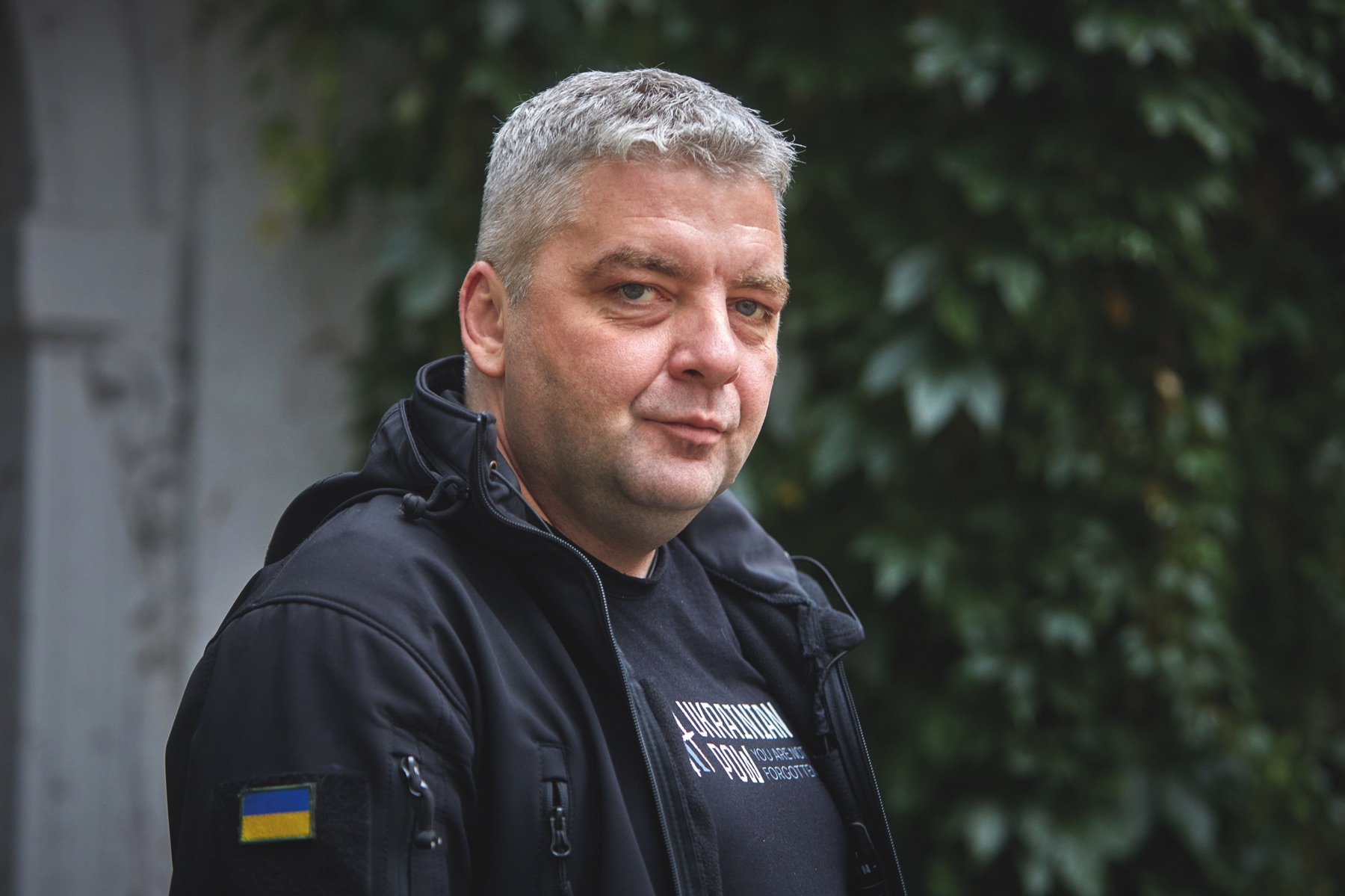
Maksym Butkevych
Text: Sabina Tančevová; Photo: Ondřej Němec, Knihovna Václava Havla
Pre-2022
Maksym Butkevych worked as a journalist at Radio Hromadske in 2012 and 2013, and in 2014 he reported on the Euromaidan revolution from the centre of Kyiv. A former collaborator with BBC World Service, he was also an activist, fighting against racism, right-wing extremism, and hate speech in the media and public sphere.
Within the No Borders project, he was involved in helping asylum seekers. These were mainly refugees from Russia, Central Asia, the Middle East, Africa, and Belarus, but also internally displaced Ukrainians driven from their homes by war since 2014. Maksym Butkevych is a Ukrainian journalist, human rights defender, and co-founder of both the Human Rights Centre ZMINA and the news outlet Hromadske – and it was he who was awarded this year’s Václav Havel Human Rights Prize. Despite being a lifelong pacifist, Butkevych voluntarily joined the Ukrainian Armed Forces at the beginning of the Russian full-scale invasion in 2022, becoming a platoon commander. Captured and sentenced to 13 years by Russian forces, he was held for over two years in harsh conditions before being released in a prisoner exchange in October 2024. He remains a powerful symbol of courage and perseverance in the defence of justice and freedom.

Maksym Butkevych with the Minister of Foreign Affairs of the Czech Republic Jan Lipavský
The invasion’s impact
After the full-scale invasion of Ukraine in 2022, Butkevych decided to take up arms and defend his country. At that time, he had been involved in human rights issues for over 15 years and had been closely monitoring the situation (and its rapid deterioration) in that regard in Russia, realising what would happen if Russia was victorious. In an interview with the Havel Channel during his visit to Prague as laureate of the Václav Havel Human Rights Prize, the 48-year-old said that if Russia were to prevail in its aggression against Ukraine then everything that has been achieved in Ukraine in the field of human rights will be destroyed, and human rights activities will be snuffed out in the country. This is because the Russian system does not consider the concept of human rights to be important; on the contrary, Moscow’s current ideology goes against human dignity and human rights. Butkevych said that if he wanted to be considered a defender of human rights, he had no choice but to sign up for the army. In the interview, he also emphasised that he rejects violence as a means of achieving political goals because of its dehumanising effect. However, if it is necessary to stop aggressors by force, taking up arms is the only alternative; otherwise we become accomplices. It was not easy for him, but, as he told the Havel Channel, he understood that only extreme options were available to defend what was important.
His experience from his initial combat missions – when he participated in the liberation of the Kyiv region and saw the consequences of the Russian occupation – only confirmed what he already knew about the Russian regime. Unfortunately, his knowledge later deepened considerably when he was taken prisoner in the Luhansk region. He was interrogated, sometimes formally, sometimes violently. He and other prisoners were forced to repeat Russian propaganda without hesitation under threat of violence. It was clear that the occupiers were trying to shake their faith and morale, or even win some of them over to their side. Many prisoners were forced to appear in propaganda videos; when they refused, the Russians subjected them to violence and torture. They were forced to do intense physical exercise until some collapsed. Medical treatment in detention was almost non-existent, except for cases of serious injury.
In March 2023, criminal proceedings were initiated against him, and he was sentenced to 13 years and transferred to another part of the prison in the so-called Luhansk People’s Republic, where those accused of criminal offences were held. They had completely different, far superior, conditions.
However, there was never a moment when he did not believe he would get out. He was convinced his loved ones, colleagues, friends, and fellow activists would not abandon him. Of course, he had no idea how long it would take, or whether his health would fail him – but even that would have been a way out. He never believed he would serve the full term.
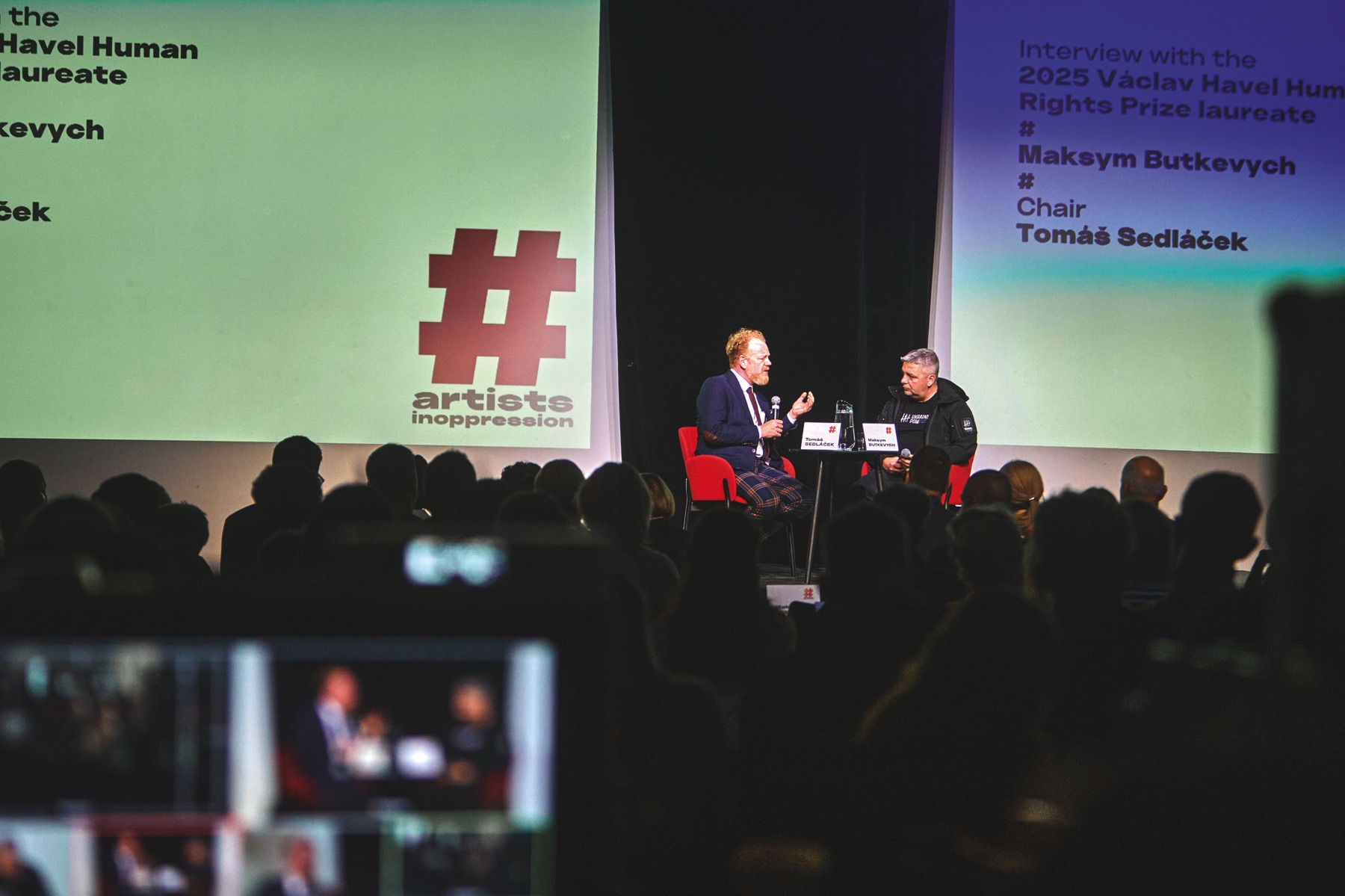
Maksym Butkevych with the Director of Václav Havel Library Tomáš Sedláček at the 13th annual International Conference in Honour of the Laureate of the 2025
Václav Havel Human Rights Prize
After the release
Following his release under a prisoner exchange, Butkevych spent time at a Ukrainian Armed Forces centre, which he said was greatly beneficial. He then returned to his native Kyiv, which seemed lovelier to him than ever before. After rehabilitation, he was given a month off, as he was still an active member of the army. It took him two months to decide whether to continue as a soldier or leave, as permitted by law. He thought long and hard about where he would be most useful. After consulting with friends and colleagues, both civilians and soldiers – who, unlike him, had not lost two years of their lives – he decided to step down from active service. However, he remains in the reserve forces and holds the rank of first lieutenant.
The first two or three months after his return to freedom were, from a psychological point of view, the best period of his life. The former POW ceased to take little things – such as waking up and feeling more or less safe, making small everyday decisions, and not being constantly on guard – for granted. However, he is in rehabilitation.
Maksym Butkevych received the Stories of Injustice Award, presented by the One World in Schools educational programme run by the Czech NGO People in Need. His father, Oleksandr, came to Prague in November 2022 to accept the award on his behalf. On 30th September 2025, he was able to come in person to Strasbourg to accept the Václav Havel Human Rights Prize, before later attending an international conference in Prague organised in his honour by the Václav Havel Library.
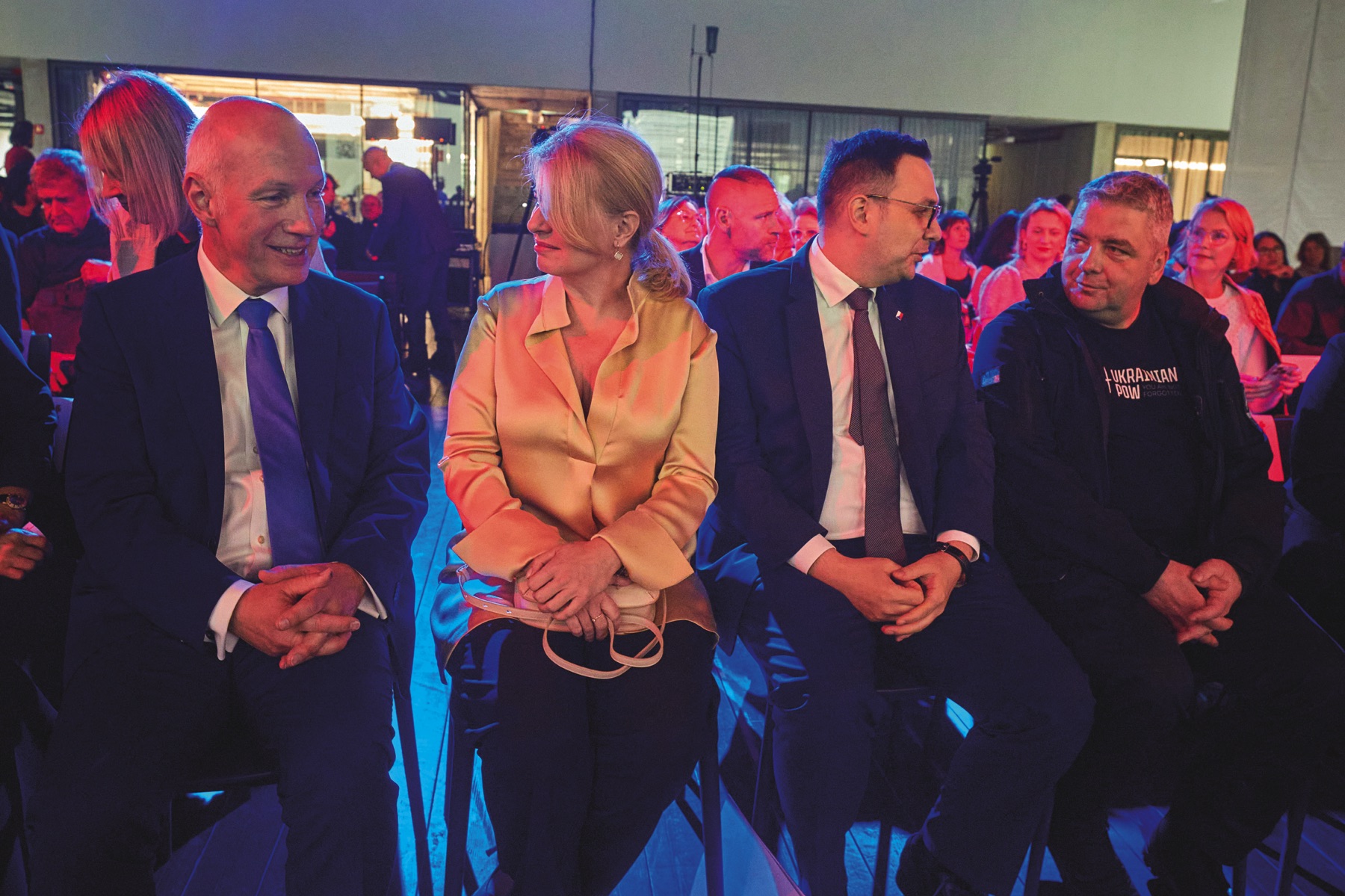
Maksym Butkevych, Minister of Foreign Affairs of the Czech Republic Jan Lipavský, former President of Slovakia Ms. Zuzana Čaputová, and Czech Senator Pavel Fischer
 SABINA TANČEVOVÁ graduated in theatre production from the Theatre Faculty of the Academy of Performing Arts in Prague in 1997. Early in her career, she worked at the Office of the President of the Czech Republic and later at Václav Havel’s private office as his secretary. Her professional focus has been on protocol and international relations.
At the Václav Havel Library, she is responsible for foreign relations and human rights, overseeing related public club evening events and their production, combining her expertise in theatre, protocol, and cultural management.